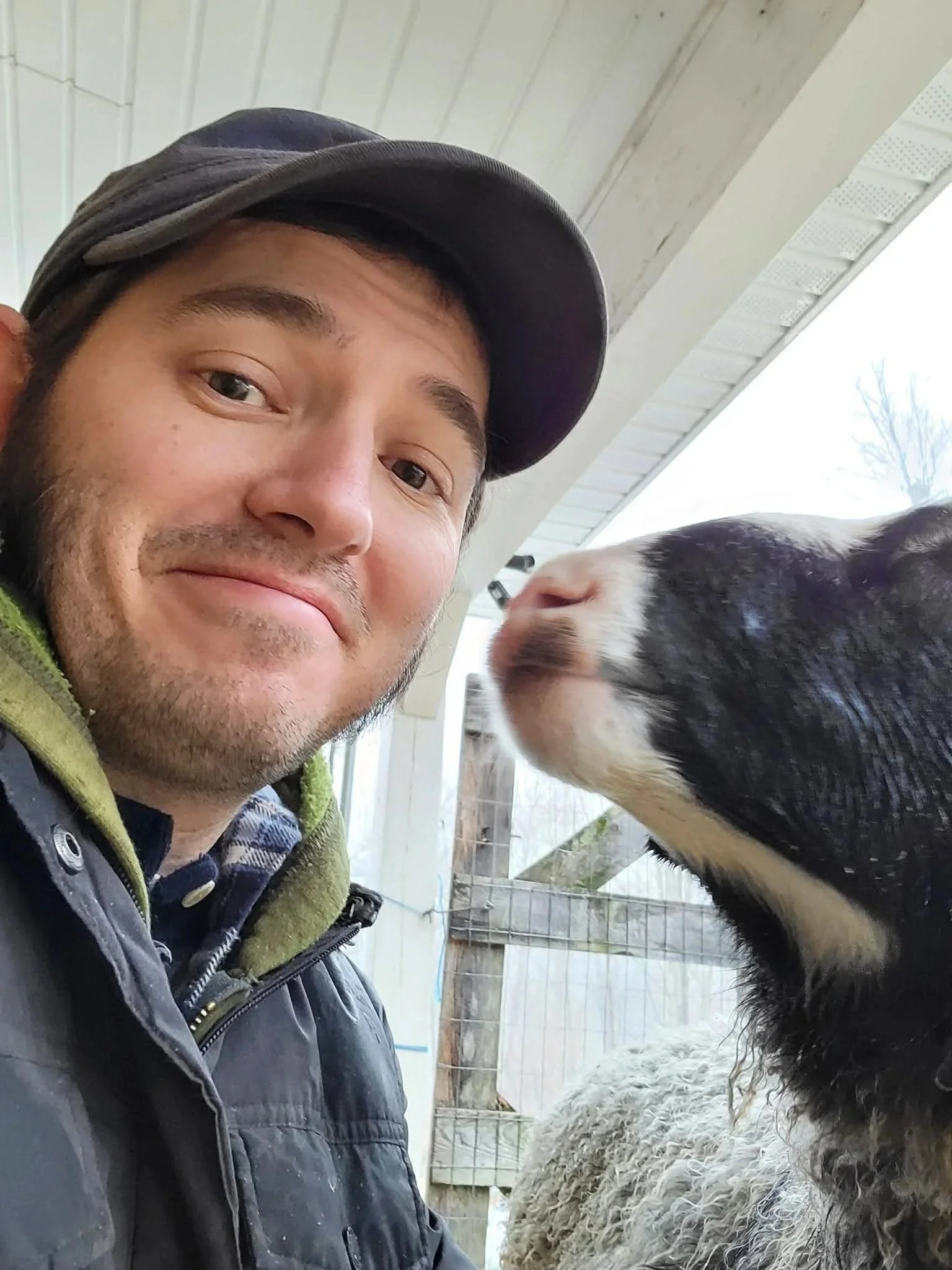
Steve with a friendly sheep he met at a Vermont farm.
BPHC works closely with the Burlington School District on lots of different work that supports substance misuse prevention and health and wellness in our district and community. The Student Assistance Program (SAP) Counselors at the middle schools and high school are some of our strongest partners. Our Director, Mariah, was excited to sit down with Hunt's new SAP, Steve Dercole, to learn more about him and his plans for the role.
Mariah: Tell me about yourself and what brought you to this position at Hunt Middle School.
Steve: I grew up in New Jersey and got into the field later in life. I started off my career in the corporate world, but I did not enjoy it. I went back to school because I wanted a job where I could actually help people and I got a degree in Psychiatric Rehabilitation, then I worked in homeless outreach for about a year.
After that I facilitated group therapy with young people at an intensive outpatient clinic for about 4-5 years. Then I moved to upstate NY, where I found a job in substance misuse counseling. I came into that work by accident. I wasn’t looking to work with people who had substance use dependence, but I found that I liked the work and the people.
Recently, I decided to move to Vermont to be closer to my three daughters who live here, and everything fell into place with this position at Hunt. I have always wanted to work in a school, and when I applied to this job I got a call for an interview right away and I was hired almost immediately. I moved to Vermont and started as the Student Assistance Program Counselor at Hunt in August.
Mariah: What is the role of a Student Assistance Program Counselor at Hunt Middle School?
I’m new so I’m still learning about the role, but right now I’ve come to look at it like a Swiss Army Knife. Whatever tool is needed I try to apply that. There are two main parts to my role. One is to see students individually. In this role I can support any student for any reason. It might be for struggles with mental health, substance use, behavior issues, family challenges, etc. My background is in mental health counseling, so I do end up using that experience with kids who come to see me.
The other part of my role is prevention. I help with running in school and after school groups called BE Above for students to be involved in supporting healthy choices and positivity for young people. I might also be involved in supporting policy and procedure implementation and improvement. I’ll also support whole school activities such as assemblies, themed weeks, and advisory activities that can engage students in conversation or educate about substance use and other health issues.
Mariah: What do you like about working with middle schoolers?
Steve: I like the earnestness. You ask them a question - they almost always answer honestly. They want to do well. They want to help. There is not the self consciousness or jadeness of working with adults. When you ask them what they want, they will tell you. They will be real with you and I like that. I remember vividly what it was like to be that age, middle school is a tough time. If I can intervene and be that person that I did not have -- if I can help with keeping someone away from the angst and anxiety that I went through, it is a nice role to be able to play.
Mariah: What are some of the main issues you see middle schoolers navigating today?
Steve: I’m still learning about that. There are a lot of social dynamics going on at this age. The big issue or challenge that I’ve seen so far seems to be the “buy-in”. They want to know “How do I benefit from this?” “Why should I go to class, why should I make an effort? Why social studies? What is in it for me?” I see my role is to help them to care and to see that value for themselves.
Mariah: What substance use issues are you seeing the most often at Hunt?
Steve: Fortunately, we haven’t really seen any substance use issues at Hunt so far this year. We have heard a little about potential vaping issues, but so far not much. I am seeing more of the pre-behaviors that we know have the potential to lead to substance use in the future, such as, absenteeism, truancy, not going to class, disengagement, and acting out behavior. Some of this is normal stuff for this age but we want to keep an eye on it to make sure kids have enough guardrails to keep it from leading to more troubling issues.
Mariah: What else do you want people to know about your role and the services you provide?
Steve: My role is to give kids a safe space to have someone to talk to, my role is not discipline or authority. I’m not a friend and I’m not an authority. Kids call me “Mr. Steve” - to show we are in a middle ground where I can just be a support and give kids a place to talk and work through issues and goals.
I also want parents to know that they have a huge influence with their middle schoolers. I have a kid that is in 7th grade myself, and I understand how at this age kids are pushing away more. I have experience with family counseling and I am available to help with conversations with your kids to work through challenging behaviors or situations. Parents can call me too.